
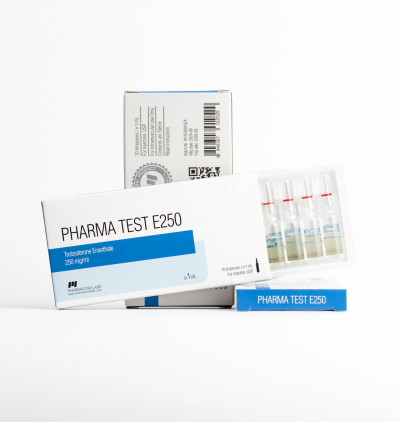
PHARMATEST E 250 Ampules
$80.00
Activity Half-Life: 4.5-5 days
Water Retention: Yes
Classification: Anabolic Steroid
HBR: Perhaps
Dosage: Men 250-1500 mg/week
Hepatotoxicity: No
Acne: Yes
Aromatization: Yes
Description
Buy PHARMATEST E 250 Ampules: The Trusted Testosterone Enanthate for Mass-Building Cycles
Activity Half-Life: 4.5-5 days
Water Retention: Yes
Classification: Anabolic Steroid
HBR: Perhaps
Dosage: Men 250-1500 mg/week
Hepatotoxicity: No
Acne: Yes
Aromatization: Yes
PHARMATEST E 250 Ampules contain Testosterone Enanthate, one of the most effective mass-building anabolic steroids available and highly recommended as the foundational base of any serious bulking cycle. Each 1 ml ampule delivers 250 mg of testosterone enanthate, equivalent to 180 mg of pure testosterone. Testosterone is responsible for promoting health and well-being through enhanced libido, energy, immunity, increased fat loss, gaining and maintaining lean muscle mass, preventing osteoporosis (loss of bone density), and possible protection against heart disease. It combines excellently with many other compounds both oral and injectable as part of a potent stack.
With a half-life of approximately 4.5-5 days, testosterone enanthate is a slow-release ester similar to Testosterone Cypionate. Clinical pharmacokinetic research in non-human primates has reported that following a single intramuscular injection, serum testosterone levels rise significantly within 24 hours and remain elevated for 3-5 days before declining. Mean half-life estimates of the terminal elimination phase have been reported as approximately 5 days for testosterone enanthate in primate models . This extended-release profile allows for less frequent injections while maintaining stable blood androgen levels, making it a practical choice for cycle management.
Testosterone enanthate is widely recognized in clinical medicine as a testosterone replacement therapy for male hypogonadism when testosterone deficiency is confirmed by clinical symptoms and biochemical testing . The pharmaceutical formulation consists of a clear, yellowish oily solution containing 250 mg of testosterone enanthate per ampule with refined castor oil and benzyl benzoate as excipients .
Mechanism of Action
Testosterone enanthate functions as a long-acting androgen receptor agonist. Following intramuscular injection, the enanthate ester is gradually cleaved by nonspecific esterases, releasing free testosterone into the bloodstream at a controlled rate. This exogenous testosterone binds to androgen receptors in target tissues, initiating anabolic effects including enhanced nitrogen retention and increased protein synthesis within muscle cells.
Clinical research has demonstrated that testosterone enanthate administration significantly increases muscle protein synthesis. A study published in the Journal of Applied Physiology found that a pharmacological dose of testosterone enanthate (3 mg/kg weekly for 12 weeks) increased muscle protein synthesis by approximately 27% in normal male subjects, with muscle mass estimated by creatinine excretion increasing by 20% . Additional research in patients with myotonic dystrophy confirmed that testosterone enanthate administration resulted in a significant increase in muscle protein synthesis, with muscle ribonucleic acid content rising significantly in response to treatment, suggesting that testosterone initiates its effect by hormone receptor interaction with muscle nuclei .
More recent research on the effects of testosterone during energy deficit has demonstrated that exogenous testosterone exerts a broad stimulatory effect on synthesis rates across the muscle proteome, resulting in muscle mass accretion during subsequent recovery . Studies have shown that testosterone administration (200 mg weekly) during severe caloric deficit attenuates lean body mass loss, preserving approximately 2.5 to 3.8 kg more lean mass compared to placebo .
The pharmacokinetic profile of testosterone enanthate has been well-characterized. Following subcutaneous administration of 100 mg of testosterone enanthate, pharmacokinetic studies have reported an elimination half-life of approximately 239 hours (approximately 10 days) . Alternative studies have calculated an elimination half-life of 51 hours (approximately 2.1 days) in rodent models . The International Standard for testosterone enanthate in therapeutic applications recommends a dosage of 250 mg administered every two to three weeks, with maintenance treatment ranging from every three to six weeks depending on individual patient needs .
Product Features
-
Pharmaceutical-Grade Quality: Manufactured to rigorous pharmaceutical standards as a clear, yellowish oily solution
-
Convenient Ampule Format: Each 1 ml ampule contains 250 mg of testosterone enanthate (equivalent to 180 mg of testosterone)
-
Long-Acting Ester: The enanthate ester provides sustained testosterone release with a half-life of approximately 5 days
-
Proven Efficacy: Clinical evidence demonstrates significant increases in muscle protein synthesis (approximately 27%) and muscle mass (20% increase in creatinine excretion)
-
Versatile Application: Suitable for both bulking cycles and testosterone replacement therapy
-
Well-Established Safety Profile: Extensively studied in clinical settings with well-documented adverse effect profiles
Key Benefits
-
Significant Muscle Growth: Clinical research demonstrates that testosterone enanthate increases muscle protein synthesis by approximately 27% in normal males
-
Enhanced Muscle Mass: Studies show a 20% mean increase in muscle mass as estimated by creatinine excretion
-
Preservation of Lean Mass: Testosterone administration attenuates lean body mass loss during energy deficit, preserving approximately 2.5-3.8 kg more lean mass compared to placebo
-
Improved Recovery: Accelerates muscle repair and recovery through enhanced protein synthesis
-
Flexible Cycle Integration: Works effectively as a base in stacks with a wide range of other anabolic agents
-
Established Therapeutic Use: FDA-approved for testosterone replacement therapy in hypogonadal males
Recommended Use
PHARMATEST E 250 is typically administered via deep intramuscular injection into large muscle groups such as the gluteal muscle . Prior to initiating therapy, confirm the diagnosis of hypogonadism by ensuring that serum testosterone concentrations have been measured in the morning on at least two separate days and that these concentrations are below the normal range .
For testosterone replacement therapy in hypogonadal males, the recommended dosage is one ampule (250 mg of testosterone enanthate) injected every two to three weeks. For maintenance treatment, 250 mg is administered intramuscularly every three to six weeks, depending on individual patient needs . Healthcare providers should measure serum testosterone levels before starting treatment and periodically during treatment at the end of the dosing interval, adjusting the dose if necessary .
In performance enhancement contexts, dosages are often significantly higher than therapeutic ranges, typically ranging from 250 to 1500 mg per week. Users should be aware that exogenous testosterone administration will suppress natural testosterone production, which may lead to azoospermia . Proper post-cycle therapy (PCT) is essential to restore endogenous hormonal function after a cycle. Regular monitoring of hematocrit, blood pressure, lipid profiles, and prostate-specific antigen (PSA) is strongly advised .
Side Effects
Potential side effects associated with testosterone enanthate include:
-
Hematological Effects: May increase red blood cell mass (polycythemia). Monitor hematocrit approximately every 3 months to detect increased red blood cell mass. The most commonly reported adverse reactions (>5%) include hematocrit increased, hypertension, PSA increased, injection site bruising, and headache .
-
Cardiovascular Risks: Testosterone can increase blood pressure, which can increase cardiovascular risk over time. Measure blood pressure periodically. Not recommended for use in men with uncontrolled hypertension . Testosterone may increase the risk of cardiovascular events .
-
Venous Thromboembolism: Deep vein thrombosis (DVT) and pulmonary embolism (PE) have been reported in patients using testosterone products. Evaluate patients with signs or symptoms consistent with DVT or PE .
-
Androgenic Effects: Acne, oily skin, accelerated hair loss in genetically predisposed individuals, and increased body hair. Acne and skin reactions have been reported .
-
Estrogenic Effects: Aromatization to estradiol may lead to gynecomastia and water retention; aromatase inhibitors may be necessary
-
Prostate Effects: May worsen benign prostatic hyperplasia (BPH) symptoms. Monitor patients with BPH for worsening signs and symptoms. Monitor prostate-specific antigen (PSA) periodically .
-
Suppression of Natural Testosterone: Exogenous administration of androgens may lead to azoospermia and testicular atrophy .
-
Other: Edema with or without congestive heart failure may occur in patients with pre-existing cardiac, renal, or hepatic disease. Sleep apnea may occur in those with risk factors. Depression and suicidal ideation and behavior have occurred during clinical trials in patients treated with testosterone enanthate .
Contraindications
Testosterone enanthate is contraindicated in men with carcinoma of the breast, men with known or suspected carcinoma of the prostate, patients with hypercalcemia, patients with liver tumors occurring currently or in the past, and patients with prostate adenoma . It is also contraindicated in women who are pregnant, as testosterone may cause fetal harm , and in patients with known hypersensitivity to testosterone enanthate or any of its ingredients . Testosterone enanthate should not be used in women .
This product should only be used under the guidance of a qualified healthcare professional.
Top 10 Frequently Asked Questions
1. What is the half-life of Testosterone Enanthate?
The half-life of Testosterone Enanthate is approximately 4.5-5 days. Clinical pharmacokinetic research in non-human primates has reported mean half-life estimates of the terminal elimination phase of approximately 5 days . Alternative studies have reported an elimination half-life of 51 hours (approximately 2.1 days) in rodent models . Pharmacokinetic data from clinical studies in humans has reported a half-life of 172.57 hours for intramuscular testosterone enanthate .
2. What is the recommended dosage for Testosterone Enanthate?
For testosterone replacement therapy in hypogonadal males, the recommended dosage is one ampule (250 mg) injected every two to three weeks. For maintenance treatment, 250 mg is administered intramuscularly every three to six weeks, depending on individual patient needs . In performance enhancement contexts, dosages typically range from 250 to 1500 mg per week. Always follow a healthcare professional’s guidance.
3. How does Testosterone Enanthate compare to Testosterone Cypionate?
Testosterone Enanthate and Testosterone Cypionate are functionally interchangeable medications with similar half-lives. Enanthate has a half-life of approximately 4.5-5 days, while Cypionate has a slightly longer half-life of approximately 8 days. Both provide sustained release and similar anabolic effects. They are used interchangeably in clinical practice for testosterone replacement therapy.
4. How quickly does Testosterone Enanthate work?
Following a single intramuscular injection, serum testosterone levels rise significantly within 24 hours . Clinical research has demonstrated that muscle protein synthesis increases significantly within days of testosterone administration. A study by Griggs et al. found that testosterone enanthate increased muscle protein synthesis by approximately 27% in normal male subjects over a 12-week period .
5. What is the best injection frequency for Testosterone Enanthate?
For therapeutic purposes, the FDA-approved labeling recommends administration every two to three weeks for initiating therapy, with maintenance treatment every three to six weeks . For performance enhancement purposes, many users administer testosterone enanthate once or twice weekly to maintain stable blood levels and minimize fluctuations.
6. Does Testosterone Enanthate convert to estrogen?
Yes, Testosterone Enanthate aromatizes to estradiol. This can lead to estrogenic side effects such as gynecomastia and water retention, which may require the use of an aromatase inhibitor. Estradiol levels should be monitored periodically during treatment .
7. Is a Post-Cycle Therapy (PCT) necessary after a cycle?
Yes. Exogenous testosterone suppresses the body’s natural production of testosterone and may lead to azoospermia . A PCT protocol using medications like Selective Estrogen Receptor Modulators (SERMs) or Human Chorionic Gonadotropin (hCG) is essential to restore endogenous testosterone production. Patients should be monitored for signs of recovery of endogenous testosterone production.
8. What are the most common side effects of Testosterone Enanthate?
The most commonly reported adverse reactions (>5%) include hematocrit increased, hypertension, PSA increased, injection site bruising, and headache . Other reported side effects include acne, gynecomastia, suppression of natural testosterone production, mood alterations, and changes in libido . Depression and suicidal ideation have occurred during clinical trials .
9. What steps should be taken before starting a cycle?
Before starting therapy, confirm the diagnosis of hypogonadism by measuring serum testosterone in the morning on at least two separate days to ensure levels are below the normal range . Baseline blood work should include complete blood count (with hematocrit monitoring), lipid panel, liver function tests, prostate-specific antigen (PSA), and total/free testosterone levels. Monitor patients with benign prostatic hypertrophy for worsening symptoms . Testosterone products are not recommended for use in men with uncontrolled hypertension .
10. Is Testosterone Enanthate suitable for women?
Testosterone enanthate is contraindicated in women who are pregnant, as testosterone may cause fetal harm . The use of testosterone in women is generally limited to specific medical contexts and is not recommended for use in healthy women due to virilizing effects .
Ready to take your physique to the next level?
Secure your supply of PHARMATEST E 250 Ampules from a trusted source. Visit anabolicsteroidsonline.shop today to order and begin your journey to unprecedented muscle growth and strength.
Related products
-
- -17%
- HGH & Peptides, Injectable Anabolic Steroids
Shogun Peptides HGH 100 iu – 10 x 10iu Vials
- Original price was: $300.00.$250.00Current price is: $250.00.
- Add to cart
Reviews
There are no reviews yet.