Where Can I Buy Peptides Online? A Buyer’s Guide to Safe & Legal Research Peptides
The landscape of performance optimization, biohacking, and tissue recovery has shifted dramatically over the last few years. Traditional approaches are increasingly sharing the spotlight with cellular medicine—specifically, peptide therapy. Whether you are a competitive athlete looking to accelerate soft tissue repair, a bodybuilder aiming to optimize growth hormone secretion, or a biohacker focused on cellular longevity, you have likely asked yourself the pivotal question: where can I buy peptides online without compromising your safety, your wallet, or the law?
The internet is flooded with websites offering research peptides for sale. Some are legitimate chemical supply houses that provide stringently tested, high-purity compounds. Others are fly-by-night operations selling under-dosed, contaminated, or completely counterfeit vials manufactured in substandard overseas facilities. Because these compounds are structural chains of amino acids that dictate vital biological signals in the body, compromising on quality isn’t just a financial risk—it is a significant health hazard.
This comprehensive guide serves as your definitive roadmap to navigating the complex online marketplace for research peptides in the United States and Canada. We will break down the underlying science of the most sought-after compounds, dissect the shifting legal framework, expose the industry red flags you must avoid, and provide an actionable protocol for sourcing high-purity peptides safely and legally.
Table of Contents
- Understanding Peptides: The Molecular Signaling Network
- Deep Dive: Popular Research Peptides & Their Mechanisms
- The Legal Landscape: USA vs. Canada (2026 Update)
- How to Identify a Reputable Online Peptide Supplier
- Critical Red Flags: When to Walk Away from a Vendor
- Step-by-Step Guide to Safely Ordering Peptides Online
- Frequently Asked Questions (FAQs)
- Authoritative Resources & Educational Databases
1. Understanding Peptides: The Molecular Signaling Network
To safely navigate the marketplace, you must first understand exactly what you are purchasing. Peptides are short chains of amino acids, typically linked by peptide bonds, containing fewer than 50 amino acids. If a chain exceeds this length, it is generally classified as a protein (such as human growth hormone, which consists of 191 amino acids).
In living organisms, peptides act as highly targeted signaling molecules. They bind to specific receptors on the surface of cells, triggering a cascade of intracellular events that regulate everything from metabolic rate and immune response to cellular repair and tissue regeneration.
Why the Sudden Surge in Interest?
Unlike traditional pharmaceutical drugs, which often introduce foreign synthetic molecules to alter biological systems (sometimes resulting in heavy off-target side effects), peptide therapy benefits stem from mimicking or amplifying the body’s natural physiological pathways. Because they are highly targeted, therapeutic peptides typically possess an excellent safety profile with minimal systemic toxicity when manufactured to analytical-grade standards.
In fields like sports medicine and regenerative anti-aging science, peptides are heavily researched for their ability to accelerate the healing of tendons, ligaments, and muscle fibers; increase lean muscle mass; decrease adipose (fat) tissue; and enhance deep, restorative slow-wave sleep.
2. Deep Dive: Popular Research Peptides & Their Mechanisms
Before looking into where to buy peptides online USA or Canadian distribution networks, researchers must understand the specific properties, mechanisms, and ongoing scientific inquiries surrounding individual compounds. The online market is largely dominated by three distinct categories: gastric-derived repair factors, synthetic thymic fragments, and growth hormone secretagogues.
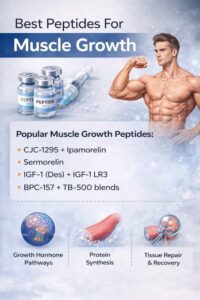
BPC-157 (Body Protection Compound-157)
BPC-157 is a pentadecapeptide composed of 15 amino acids. It is a partial sequence of a human gastric juice protein that exhibits profound cytoprotective (cell-protecting) and regenerative properties.
- Primary Mechanism: BPC-157 accelerates tissue healing primarily through angiogenesis—the formation of new blood vessels from pre-existing ones. It achieves this by upregulating the expression of Vascular Endothelial Growth Factor (VEGF). Increased blood flow delivers vital oxygen and nutrients to notoriously poorly vascularized tissues, such as tendons and ligaments.
- Research Areas: Clinical and preclinical studies indexed on databases like the National Institutes of Health (NIH) demonstrate its efficacy in healing transected Achilles tendons, mending torn skeletal muscle, accelerating bone fracture repair, and resolving systemic inflammatory bowel conditions.
- Targeted Outcome: Accelerated recovery from acute structural injuries and chronic joint degradation.
TB-500 / Thymosin Beta-4
Often paired with BPC-157 in recovery protocols, TB-500 is a synthetic version of the naturally occurring 43-amino-acid peptide Thymosin Beta-4, which is found in high concentrations in blood platelets and healing tissues.
- Primary Mechanism: Unlike BPC-157, which acts locally at the injury site, TB-500 exhibits profound systemic effects due to its low molecular weight, allowing it to travel long distances through tissue. Its primary mechanism centers on the upregulation of actin, a vital cellular protein critical for cell migration, proliferation, and structural remodeling.
- Research Areas: TB-500 is heavily researched for its ability to reduce localized inflammation, improve joint flexibility, promote dermal wound healing, and protect cardiovascular tissues following ischemic events.
- Targeted Outcome: Systemic reduction of soft tissue inflammation and rapid cellular migration to active injury sites.
CJC-1295 & Ipamorelin (The Secretagogue Dynamic Duo)
When individuals look for legal peptides for bodybuilding or age management, they frequently encounter the combination of CJC-1295 and Ipamorelin. These compounds work synergistically to stimulate the pituitary gland to release endogenous (the body’s own) growth hormone.
- CJC-1295 (with DAC or No DAC): This is a synthetic analog of Growth Hormone-Releasing Hormone (GHRH). It mimics natural GHRH to signal the pituitary gland to release growth hormone pulses. When sold as “CJC-1295 No DAC” (also known as Mod GRF 1-29), it provides short, sharp pulses mimicking natural physiological rhythm.
- Ipamorelin: This is a highly selective Growth Hormone Secretagogue (GHS) that acts as a ghrelin receptor agonist. It binds to the growth hormone secretagogue receptor, prompting a secondary pulse of growth hormone. Crucially, unlike older secretagogues like GHRP-2 or GHRP-6, Ipamorelin does not cause a spike in cortisol (the stress hormone) or prolactin, nor does it induce intense hunger.
- The Synergy: When co-administered in clinical models, a GHRH analog and a GHS create a amplified effect. The GHRH clears the path and initiates the pulse, while the GHS amplifies the volume of the pulse, resulting in significantly higher cellular uptake of growth hormone without shutting down the body’s natural endocrine production.
3. The Legal Landscape: USA vs. Canada
Understanding the legalities of buying peptides online is paramount. The regulatory framework dictates how these compounds can be bought, shipped, and possessed, and misinterpreting these laws can lead to severe civil or criminal complications.
+------------------------------------------------------------------------------------+
|                                IMPORTANT NOTICE                                    |
| Almost all unapproved peptides sold online by chemical vendors are legally sold    |
| strictly as "Research Chemicals" intended for "In Vitro Laboratory Evaluation" or  |
| "Animal Research Purposes Only." They are NOT approved for human consumption.     |
+------------------------------------------------------------------------------------+
United States Framework
In the USA, the Food and Drug Administration (FDA) strictly regulates compounds intended for human use. Under federal law, it is illegal to introduce unapproved new drugs into interstate commerce for human consumption.
- The Research Exemption: This is why legitimate domestic suppliers label their products explicitly for research purposes. Selling these compounds to laboratories, researchers, and universities for testing is entirely legal under federal law, provided the vendor does not cross the line into marketing them for human use, offering dosing guides, or making medical health claims.
- WADA and Professional Sports: For competitive athletes, it is vital to check the World Anti-Doping Agency (WADA) prohibited list. Most growth hormone secretagogues (like CJC-1295 and Ipamorelin) and metabolic modifiers are strictly classified as banned substances in and out of competition.
Canadian Framework
Health Canada maintains a rigid stance on peptide distribution. Under the Food and Drugs Act, many therapeutic peptides fall under Schedule F or the Prescription Drug List.
- Customs and Importation: If you attempt to import peptides from international sources into Canada without a valid drug establishment license or a specialized physician prescription, Canadian Border Services Agency (CBSA) agents have the authority to seize the package at the border.
- Domestic Sourcing: Consequently, Canadian researchers looking to avoid border seizures universally prefer sourcing from verified domestic Canadian research laboratories that operate legally within provincial borders, shipping packages via Canada Post without cross-border customs checks.
4. How to Identify a Reputable Online Peptide Supplier
When you are ready to identify where can I buy peptides online, you must transform from a passive consumer into an analytical auditor. Reputable suppliers do not hide behind sleek marketing; they lead with transparent raw data.
1. Verifiable Third-Party Testing (HPLC & MS)
This is the gold standard of safety. A legitimate vendor must provide recent, batch-specific High-Performance Liquid Chromatography (HPLC) and Mass Spectrometry (MS) analysis reports.
- HPLC measures the precise purity of the peptide chain. You should never settle for anything less than 98.0% purity.
- MS confirms the identity of the molecule, proving that the lyophilized (freeze-dried) powder inside the vial is actually the exact sequence of amino acids you paid for.
- The Verification Test: Check that the Certificate of Analysis (CoA) is issued by an independent, recognizable third-party laboratory (such as MZ Biolabs or Janoshik) and contains a verifiable report number or QR code that allows you to cross-reference the data directly with the testing lab.
2. Analytical Grade Lyophilization
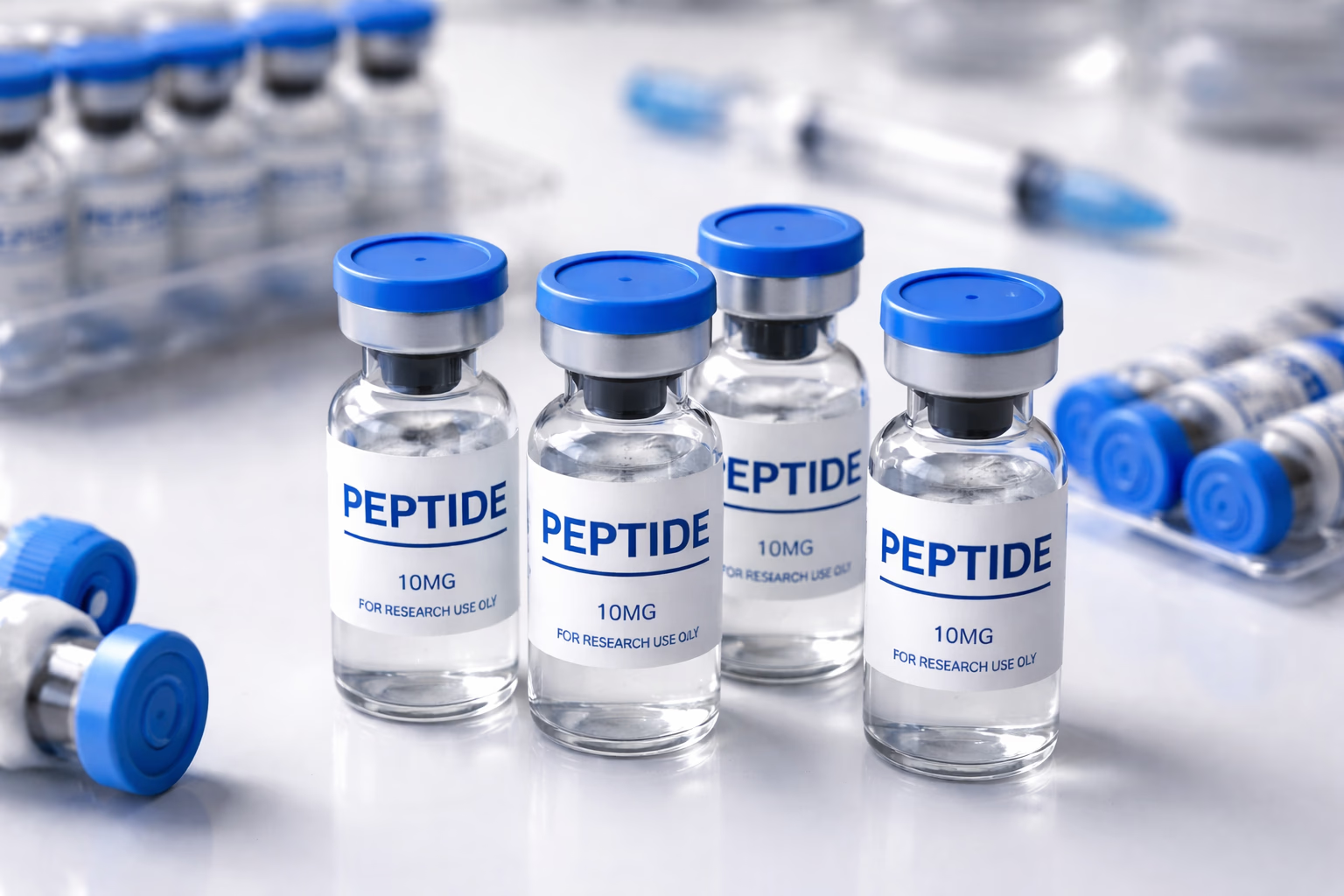
Peptides are highly fragile structures. Exposure to heat, moisture, and ambient light can degrade the delicate peptide bonds, rendering the product useless or filled with degraded impurities. Reputable vendors use industrial-grade lyophilization setups to pull all moisture out of the vial under a vacuum, sealing it with a medical-grade flip-top rubber stopper. This ensures structural stability during shipping across the USA and Canada.
3. Transparent Domestic Logistics
Top-tier vendors provide fast, trackable shipping via major carriers (USPS, FedEx, Canada Post). They wrap their vials in protective, temperature-buffered bubble inserts to mitigate mechanical shock during transit, and they provide instant tracking information.
5. Critical Red Flags: When to Walk Away from a Vendor
Navigating the online peptide market requires a keen eye for deceptive business practices. If you run into any of the following characteristics on a website selling research peptides for sale, close the tab immediately.
- Prescription/Human Dosing Guides: If a website selling unapproved research peptides includes explicit instructions on how to inject them into humans, detailed bodyweight dosing calculators, or human safety cycles, they are operating in direct violation of FDA and Health Canada compliance mandates. These sites are high-priority targets for regulatory shutdowns and domain seizures.
- Bizarrely Low Prices: The synthesis of ultra-pure amino acid sequences requires high-end equipment, specialized chemical reagents, and PhD-level microbiologists. If a site is offering 10mg of BPC-157 for a fraction of the standard market rate, they are almost certainly sourcing raw, unrefined powders from low-tier overseas factories that contain heavy metal residues, residual solvents, and structural impurities.
- Missing or Fabricated CoAs: A shocking number of sites use a single, blurred image of a Certificate of Analysis from 2021 across every product page. If a vendor cannot provide a downloadable, high-resolution, current-year CoA for the exact batch you are buying, stay far away.
- Shady, Non-Traceable Payment Schemes: Avoid sites that only accept payment through irreversible peer-to-peer apps without secure buyer verification or checkout gateways. While many legitimate research sites accept cryptocurrency due to traditional banking restrictions on research chemicals, they should always offer secure alternatives or transparent payment processing steps.
6. Step-by-Step Guide to Safely Ordering Peptides Online
If you are a qualified researcher looking to purchase compounds for legitimate in vitro or animal studies, follow this meticulous step-by-step framework to execute a safe transaction.
Step 1: Formulate Your Specific Research Protocol
Never browse a peptide catalog aimlessly. Define the exact compound, required quantity, and necessary concentration for your scientific model. This prevents over-ordering fragile compounds that have a finite shelf life when kept in storage.
Step 2: Audit and Verify the Vendor’s Testing Catalog
Navigate to the vendor’s dedicated “Testing” or “Quality Control” page. Download the latest HPLC/MS reports for your chosen compound. Match the batch or lot number listed on the report with the current inventory batch for sale.
Step 3: Assess the Digital Security Infrastructure
Ensure the website utilizes an encrypted HTTPS connection (look for the padlock icon in your browser’s address bar). Your personal shipping information and transactional meta-data should never be processed over an insecure, unencrypted server.
Step 4: Choose a Secure Payment and Shipping Method
Select a payment method that aligns with your security preference. If using cryptocurrency, ensure you copy the exact wallet address to prevent lost funds. Opt for expedited, trackable shipping to reduce the amount of time the fragile, un-reconstituted peptides spend sitting in fluctuating temperatures inside sorting facilities.
Step 5: Post-Receive Inspection and Storage
Upon delivery, immediately inspect the box. The vials should arrive tightly sealed, vacuum-packed, with the lyophilized cake intact at the bottom of the glass vial. If the cake has completely collapsed into a wet sludge, the vacuum seal was likely broken in transit, exposing the compound to ambient moisture.
Store your un-reconstituted, freeze-dried vials in a dark, temperature-controlled environment—ideally a stable laboratory refrigerator at 2–8°C (36–46°F) for short-term research, or a deep freezer at -20°C for long-term multi-year preservation.
7. Frequently Asked Questions (FAQs)
Do I need a prescription to buy peptides online?
If you are purchasing peptides labeled explicitly as “Research Chemicals” for laboratory use or in vitro study, a medical prescription is not required, as these items are not being sold or purchased as consumer drugs. However, if you are seeking peptides for personal therapeutic clinical use in humans, you must obtain a valid prescription from a licensed medical physician and have it fulfilled through a specialized compounding pharmacy.
Are peptides legal to buy and possess in Canada?
In Canada, you can legally buy and possess peptides for non-human research purposes. However, importing unregistered peptides for human use across international borders without explicit regulatory authorization is illegal and frequently results in package confiscation by the CBSA. Canadian researchers should always prioritize verified domestic Canadian suppliers to ensure compliant transit.
What is the difference between a research peptide and a prescription peptide?
The core difference lies entirely in manufacturing regulatory oversight and intended marketing use. Prescription peptides are produced in heavily audited, current Good Manufacturing Practice (cGMP) facilities, specifically approved for human administration, and prescribed by doctors. Research peptides are identical in molecular sequence but are produced, labeled, and sold strictly for laboratory testing, scientific evaluation, and experimentation.
Can I mix different peptides together in the same solution?
In scientific research models, combining multiple un-reconstituted peptides into a single syringe or storage vial prior to complete liquidation is highly discouraged. Different amino acid structures have varying chemical stability rates and pH requirements; blending them prematurely can cause rapid structural degradation or unintended molecular binding.
How long do peptides remain stable after reconstitution?
Once a lyophilized peptide is reconstituted using bacteriostatic water (sterile water mixed with 0.9% benzyl alcohol as a preservative), its shelf-life degrades rapidly. The solution must be stored continuously in a refrigerator and used within 30 to 60 days. Rough mechanical handling, shaking the vial violently, or exposing it to direct UV sunlight will break down the delicate amino acid bonds much faster.
8. Authoritative Resources & Educational Databases
To further expand your knowledge base on peptide safety, clinical research data, and evolving regulatory mandates, consult these trusted institutional platforms:
- U.S. Food and Drug Administration (FDA): Explore official safety warnings, regulatory policy classifications, and lists of unapproved compounding bulk substances via the FDA Official Website.
- National Center for Biotechnology Information (NCBI / PubMed): Access thousands of peer-reviewed clinical studies, biochemical breakdowns, and animal trial data for BPC-157, TB-500, and secretagogues on PubMed.
- World Anti-Doping Agency (WADA): Stay updated on which peptide secretagogues, growth factors, and metabolic modulators are strictly banned in competitive athletic disciplines by checking the WADA Prohibited List.
Take Action on Your Research Goals
Ready to explore premium options for your research setting? Making informed decisions requires choosing a platform that understands quality manufacturing standards and legal compliance framework guidelines.
Explore verified, analytical-grade compounds and take your experimental protocols to the next level by visiting our verified digital storefront.