
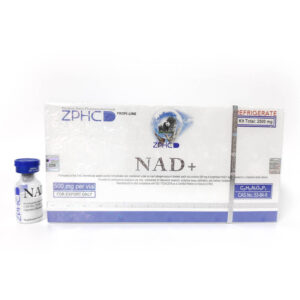
ZPHC NAD+ 1000mg Kit (Lyophilized Powder + Bacteriostatic Water)
Original price was: $68.00.$60.00Current price is: $60.00.
Description
ZPHC NAD+ 1000mg Kit
High-Purity Nicotinamide Adenine Dinucleotide for Advanced Research Applications
Product Overview
The ZPHC NAD+ 1000mg Kit provides laboratory-grade Nicotinamide Adenine Dinucleotide (NAD+) in a convenient lyophilized powder format, complete with bacteriostatic water for reconstitution. This comprehensive kit is designed for researchers investigating cellular energy metabolism, mitochondrial function, and NAD+ restoration pathways.
NAD+ is an essential coenzyme found in every living cell, playing a fundamental role in redox reactions and regulating cellular catabolic pathways . As a key substrate for sirtuins, PARPs, and CD38 enzymes, NAD+ is indispensable for maintaining cellular homeostasis, growth, and survival .
Kit Components
-
1 vial containing 1000mg lyophilized NAD+ powder (β-Nicotinamide Adenine Dinucleotide, oxidized form)
-
1 vial bacteriostatic water for reconstitution
-
High-purity laboratory-grade material with batch verification
-
Hermetically sealed sterile vials for research use only
Technical Specifications
| Parameter | Detail |
|---|---|
| Compound | β-Nicotinamide Adenine Dinucleotide (oxidized form) |
| CAS Number | 53-84-9 |
| Molecular Weight | 663.43 |
| Purity | Laboratory-grade, batch-verified |
| Format | Lyophilized powder + bacteriostatic water |
| Storage (lyophilized) | Cool, dry place; protect from light |
| Storage (reconstituted) | 2-8°C, protect from light |
Research Applications
NAD+ serves as a critical research tool for investigating:
Mitochondrial Function Studies: NAD+ is essential for mitochondrial energy production through oxidative phosphorylation. The NAD+/NADH ratio determines the efficiency of mitochondrial energy production . Research applications include studying the tricarboxylic acid (TCA) cycle, fatty acid oxidation, and electron transport chain function .
Cellular Energy Metabolism: As a major electron acceptor in biological oxidations, NAD+ plays a crucial role in glycolysis, β-oxidation of fatty acids, and glutaminolysis . Researchers utilize NAD+ to study metabolic flexibility and the balance between glycolysis and oxidative phosphorylation .
Longevity and Aging Research: Declining NAD+ levels are associated with general aging and chronic disorders, including cognitive decline, sarcopenia, and metabolic diseases . NAD+ acts as a central metabolic and signaling hub regulating the hallmarks of aging .
NAD+ Restoration Studies: Scientists investigate NAD+ supplementation strategies to restore mitochondrial and organismal homeostasis. Research explores how raising cellular NAD+ through various approaches can impact cellular health and function .
Cardiometabolic Disease Models: NAD+ homeostasis disruption can lead to impaired energetics and increased oxidative stress, contributing to cardiometabolic disease pathogenesis .
Reconstitution Protocol
-
Under sterile conditions, add the supplied bacteriostatic water to the lyophilized NAD+ vial
-
Gently swirl until the powder is fully dissolved
-
Do not vortex, as this may damage the compound
-
Use immediately after reconstitution for optimal results
-
Refrigerate at 2-8°C after reconstitution and protect from light
-
Store lyophilized powder at -20°C for long-term stability
Quality Assurance
-
Batch-verified with quality control documentation
-
Hermetically sealed sterile vials
-
Laboratory-grade material >98% purity
-
Manufactured under strict quality control standards
-
For research use only; not for human consumption
Frequently Asked Questions
1. What is NAD+ and why is it important for research?
NAD+ (Nicotinamide Adenine Dinucleotide) is a coenzyme found in all living cells. It plays a critical role in redox reactions, energy metabolism, and serves as a substrate for enzymes involved in DNA repair, gene expression, and signal transduction . Research has established that NAD+ is required for over 500 enzymatic reactions and is involved in numerous evolutionarily conserved signaling pathways .
2. How should I store the ZPHC NAD+ Kit?
Store the lyophilized powder in a cool, dry place, protected from light. For long-term storage, keep at -20°C where it remains stable for up to 36 months . After reconstitution with bacteriostatic water, refrigerate at 2-8°C and protect from light. Avoid repeated freeze-thaw cycles; aliquot if necessary .
3. What is the proper way to reconstitute the NAD+ powder?
Under sterile conditions, add the supplied bacteriostatic water to the vial containing the lyophilized NAD+ powder. Gently swirl until fully dissolved. Do not vortex, as this can damage the compound. The reconstituted solution should be used promptly for optimal results .
4. What research applications is NAD+ used for?
NAD+ is used in a wide range of research applications, including cellular energy metabolism studies, mitochondrial function models, longevity pathways, and NAD+ restoration research . Specific areas of investigation include the role of NAD+ in metabolic health, neurodegenerative conditions, cardiovascular function, and the biology of aging .
5. How does NAD+ relate to mitochondrial function?
NAD+ is essential for mitochondrial function as it plays a central role in energy production through oxidative phosphorylation. The NAD+/NADH ratio determines the efficiency of mitochondrial energy production, and NAD+ is involved in the TCA cycle and fatty acid oxidation . Mitochondrial sirtuins, which are NAD+-dependent, regulate mitochondrial function and quality control .
6. Is NAD+ supplementation research supported by scientific evidence?
Numerous systematic reviews and clinical studies have examined NAD+ augmentation strategies. Research demonstrates that NAD+ precursors reliably raise NAD-related biomarkers in humans, though effects on functional outcomes are mixed and require further investigation . The safety and effectiveness of NAD+ supplementation in various clinical conditions continue to be evaluated in clinical trials .
7. What safety considerations should be observed when using this product?
This product is for research use only and is not intended for human consumption. Standard laboratory safety protocols should be followed when handling research chemicals. Studies have reported that NAD+ supplementation is generally well tolerated, with some side effects including muscle pain, nervous disorders, fatigue, sleep disturbance, and headaches . The long-term consequences of increased NAD+ require further study .
8. What are the potential benefits of NAD+ in aging research?
Research has established NAD+ as a central metabolic hub that regulates multiple hallmarks of aging . Declining NAD+ levels with age are associated with impaired biosynthesis and heightened consumption, propagating dysfunction across genomic, epigenetic, mitochondrial, proteostatic, and communicative processes . NAD+ restoration strategies have shown promise in models of neurodegenerative diseases, cardiometabolic diseases, and musculoskeletal aging .
9. How does the NAD+ biosynthesis pathway work?
NAD+ is synthesized via two primary routes in mammals: the de novo pathway (from L-tryptophan) and the salvage pathway (utilizing Vitamin B3 precursors, nicotinamide, and nicotinamide riboside) . The salvage pathway is the primary source of NAD+ in most tissues, involving the rate-limiting enzyme NAMPT and NMNAT enzymes .
10. What quality control measures are in place for this product?
Each batch of ZPHC NAD+ is batch-verified and packaged in hermetically sealed sterile vials. The product undergoes quality control testing to ensure high purity and consistency. For research use only, with documentation available upon request.
Order Now
Advance your research with the ZPHC NAD+ 1000mg Kit. Order today at https://anabolicsteroidsonline.shop/ and experience the quality of laboratory-grade research compounds.
Related products
-
- -17%
- Anti Aging
Glow Pro Mix 60mg ZPHC – (BPC-157 + TB-500 + GHK-Cu)
- Original price was: $150.00.$125.00Current price is: $125.00.
- Add to cart
-
- -7%
- Anti Aging
NAD+ ZPHC — 2500 mg KIT (5 vials × 500 mg)
- Original price was: $145.00.$135.00Current price is: $135.00.
- Add to cart
-
- -17%
- Anti Aging
Epithalon 50mg ZPHC (Lyophilized Peptide + Bacteriostatic Water)
- Original price was: $150.00.$125.00Current price is: $125.00.
- Add to cart
Reviews
There are no reviews yet.