
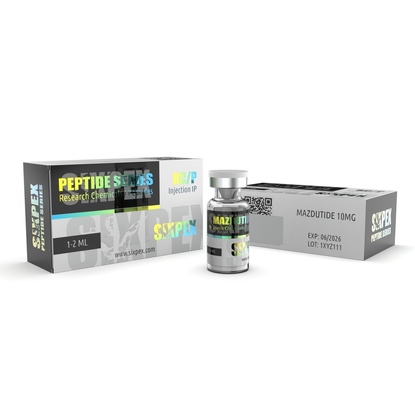
Sixpex Mazdutide 10mg US
$145.00
Product Name: Sixpex (Mazdutide)
Strength: 10 mg per vial
Form: Research-grade lyophilized powder
Component: Mazdutide (IBI-362; LY-3305677)
Mechanism: GLP-1 Receptor and Glucagon Receptor Dual Agonist
Molecular Weight: 4563.06 g/mol
Molecular Formula: C₂₁₀H₃₂₂N₄₆O₆₇
Amino Acid Sequence (Short): H-{Aib}-QGTFTSDYSKYLDEKKAK-{AEEA-AEEA-γGlu-Nonadecanoic acid}-EFVEWLLEGGPSSG-NH₂
Description
Buy Sixpex Mazdutide 10mg US
Sixpex Mazdutide is a research-grade synthetic oxyntomodulin analog that functions as a dual agonist at the glucagon-like peptide-1 (GLP-1R) and glucagon (GCGR) receptors . This 10 mg lyophilized preparation is intended for laboratory research in metabolic and endocrine studies. It has shown binding affinity for human GCGR (Ki: 17.7 nM) and GLP-1R (Ki: 28.6 nM) .
Mazdutide is a fatty acid-modified peptide designed for once-weekly administration and is part of ongoing clinical research into its potential applications for weight management, metabolic disorders, and glycemic control . The peptide is a mammalian oxyntomodulin (OXM) analogue .
Mazdutide was recently approved in China for obesity but remains investigational in the U.S. for clinical use .
Research Context
In laboratory research, mazdutide has been studied in models of diet-induced obesity (DIO), with studies documenting significant reductions in body weight in diabetic mice .
Clinical trial data from multiple phase 2 and phase 3 studies have demonstrated the following outcomes with mazdutide administration:
Weight Reduction
-
Phase 3 GLORY-1 (48 weeks): Mean weight loss of 11.0% with 4 mg dose and 14.0% with 6 mg dose vs. 0.3% with placebo .
-
Phase 3 GLORY-2 (60 weeks): Mean weight reduction of 16.65% with 9 mg dose vs. 1.50% with placebo among adults with moderate-to-severe obesity .
-
Phase 2 Study (9 mg, 24 weeks): 12.78% weight loss vs. 1.80% weight gain with placebo; 81.7% of participants achieved ≥5% weight loss .
Metabolic and Cardiovascular Benefits
-
Significant reductions in waist circumference, systolic blood pressure, triglycerides, total cholesterol, LDL cholesterol, serum uric acid, and alanine aminotransferase levels .
-
Superior efficacy to semaglutide for body weight reduction in head-to-head clinical trials .
-
Potential to improve liver fat accumulation through promotion of fatty acid oxidation .
Safety Profile
The most common adverse events observed across clinical trials were gastrointestinal in nature (nausea, vomiting, diarrhea, decreased appetite) and predominantly mild to moderate in severity . Discontinuation rates due to adverse events were low .
Product Features
-
10 mg Research Unit Size: Suitable for laboratory protocols
-
High Purity (≥99%): Manufactured to rigorous standards
-
Lyophilized Format: Stable powder for reliable reconstitution
-
Amino Acid Sequence: Peptide sequence includes Aib modification for enhanced stability
Research Applications
This product is suitable for laboratory research and preclinical studies in the following areas:
-
GLP-1/Glucagon Receptor Dual Agonist Pathway Research: Investigating signaling mechanisms and metabolic effects
-
Obesity and Metabolic Research: Evaluating effects on energy balance, appetite regulation, and lipid metabolism
-
Glycemic Control Studies: Research on glucose homeostasis and insulin sensitivity
-
Liver Fat Accumulation Research: Studying mechanisms of hepatic lipid metabolism and fatty acid oxidation
-
Cardiometabolic Research: Investigating effects on blood pressure, lipid profiles, and cardiovascular parameters
Recommended Use
This product is intended solely for laboratory research purposes. The lyophilized powder must be reconstituted using sterile technique.
Reconstitution Instructions
-
Briefly centrifuge the vial before opening to bring contents to the bottom
-
Reconstitute in sterile distilled water or appropriate aqueous buffer
-
Gently swirl until completely dissolved; do not vortex or shake vigorously
-
Apportion stock solutions into working aliquots for research protocols
Solubility Information
-
In H₂O: 22.22 mg/mL (4.87 mM; ultrasonic and adjust pH to 2 with HCl)
Storage Instructions
-
Lyophilized Powder: Store at -80°C for up to 2 years or at -20°C for up to 1 year (sealed, dry, protected from light and moisture) .
-
In Solution: Store at -80°C for up to 6 months or at -20°C for up to 1 month.
-
Avoid Repeated Freeze-Thaw Cycles: Aliquot stock solutions to prevent product inactivation .
Research Use Disclaimer
This product is intended solely for laboratory research purposes. It is not suitable for human or animal consumption, nor for medical, veterinary, or household applications. Researchers should adhere to appropriate safety protocols and institutional guidelines.
Top 10 Frequently Asked Questions
1. What is Mazdutide?
Mazdutide (IBI-362; LY-3305677) is a synthetic oxyntomodulin analog that acts as a dual agonist for the glucagon-like peptide-1 (GLP-1) receptor and the glucagon receptor (GCGR) . It is a fatty acid-modified peptide designed for once-weekly subcutaneous administration.
2. What is the mechanism of action of Mazdutide?
It binds to both GLP-1R and GCGR, activating pathways that stimulate insulin secretion, reduce appetite, and may increase energy expenditure through lipid and protein catabolism . The dual agonism may also promote fatty acid oxidation in the liver .
3. What clinical trial evidence supports Mazdutide?
Multiple phase 2 and phase 3 trials, including the GLORY-1 and GLORY-2 studies, have demonstrated significant weight loss and improvements in cardiometabolic risk factors compared to placebo .
4. What dose strengths have been studied in clinical trials?
Clinical trials have studied mazdutide at 4 mg, 6 mg, and 9 mg once-weekly doses . The 10 mg research product is provided for laboratory investigation.
5. How does Mazdutide compare to semaglutide?
In a head-to-head Phase III trial (DREAMS-3), mazdutide demonstrated superior efficacy for body weight reduction compared to semaglutide (10.29% vs. 6.00% mean weight reduction at 32 weeks) . Preclinical research also showed greater efficacy in alleviating liver fat accumulation .
6. What are the most common side effects observed in clinical trials?
Gastrointestinal adverse events including nausea, vomiting, diarrhea, and decreased appetite were most common. These were predominantly mild to moderate in severity . Discontinuation rates due to adverse events were low .
7. What metabolic benefits beyond weight loss have been observed?
Significant improvements in waist circumference, systolic blood pressure, triglycerides, total cholesterol, LDL cholesterol, serum uric acid, and liver function markers (ALT) have been reported .
8. What is the molecular identity of Mazdutide?
Molecular formula: C₂₁₀H₃₂₂N₄₆O₆₇. Molecular weight: 4563.06 g/mol. The sequence includes a fatty acid modification (AEEA-AEEA-γGlu-Nonadecanoic acid) for prolonged action .
9. How should this product be stored?
Lyophilized powder should be stored at -80°C (2 years) or -20°C (1 year) in sealed, dry conditions, protected from light and moisture. After reconstitution, store at -80°C for up to 6 months or at -20°C for up to 1 month. Avoid repeated freeze-thaw cycles .
10. Is Sixpex Mazdutide suitable for human use?
No. This product is intended solely for laboratory research purposes and is not suitable for human or animal consumption. In the U.S., mazdutide remains investigational and is not approved for clinical use .
Ready to take the next step?
Secure your supply of Sixpex Mazdutide 10mg from a trusted source. Visit anabolicsteroidsonline.shop today to explore our selection of premium research products.
Related products
-
- -37%
- SARMs & Peptide Products
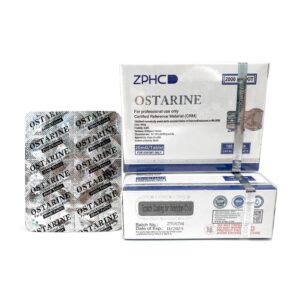
Ostarine (MK-2866) ZPHC — 20 mg (100 tablets × 20 mg)
- Original price was: $79.00.$50.00Current price is: $50.00.
- Add to cart
Reviews
There are no reviews yet.